COLUMN
お役立ち情報
2025.08.01
X-ray Fluorescence Spectroscopy – Energy Dispersive X-ray Spectrometry, XRF-EDX
Principle
By applying X-rays that generated by an X-ray tube, the energy specific to the elements contained in the sample is generated. These X-rays are detected by a Si-semiconductor detector. It examines the type of constituent elements of the sample and the composition of elements roughly. This is a non-destructive analysis method and it enables rapid elemental analysis of solids and powders.

Fig.1 Principle of XRF-EDX
When an atom is irradiated with X-rays, the electrons are ejected from the inner orbit. Outer shell electrons fall into the orbit of the inner shell. At that time, X-rays (characteristic X-rays) corresponding to the energy difference between the two orbits are emitted. This characteristic X-ray is unique to each element, so that you can know the type of element.
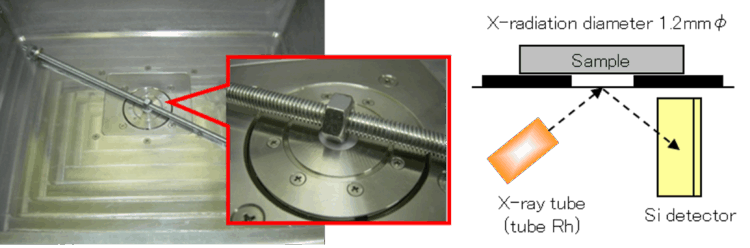
Fig.2 left: Sample installation, Right: Sketch of sample installation
The sample is placed in the sample chamber of 460 (W) mm × 360 (D) mm × 150 (H) mm and X-ray is irradiated from the bottom.

Fig.3 XGT-1000WR (HORIBA)
Application (e.g.)
- RoHS rough quantitative analysis (Cd, Pb, Cr, Hg, Br)
- Analysis of main element of materials
- Analysis of foreign materials with a size of several mm
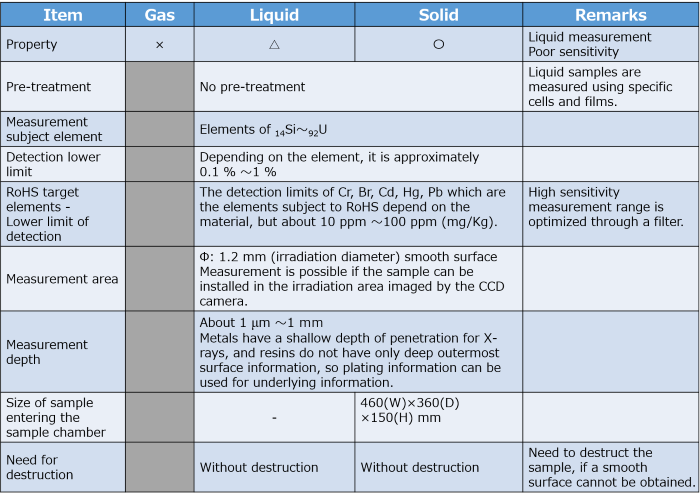
- Elemental analysis of 14Si ~ 92U with a detection limit of 0.1 % – 1 %
Acceptance conditions
Table 1 Acceptance conditions for XRF-EDX analysis