

COLUMN
お役立ち情報
2025.08.01
Principle of Ion chromatography
Principle
Ion chromatography is a method for separating and quantifying substances which exist as ions in an aqueous solution. The electrolyte solution, called as the mobile phase, is constantly pumped through a column packed with an ion exchange resin, the stationary phase. Sample ions injected into the mobile phase are separated based on the difference in their affinity with ion exchange resin. An electrical conductivity detector is used as the detector, and each ion is quantitatively analyzed.

Chromatogram is obtained through a continuous measurement of electrical conductivity.
Corresponding ion concentration is obtained from the provided peak area.
Ion chromatograph
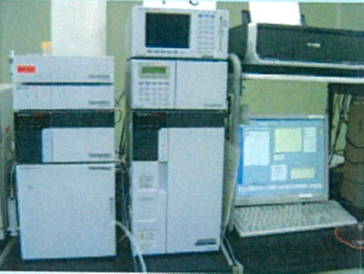
Fig.1 LC-20ADsp (SHIMADZU)
Applications
・Liquid ion concentrations i.e., drinking water, ground water, factory effluent
・Adhesion ion concentrations (extracting adhering ions with pure water)
・Ion concentrations in gas (collecting ions in gas with collection liquid)
Anion : F–, Cl–, Br–, NO2–, NO3–, SO42-, PO43-
Cation : Li+, Na+, NH4+, K+, Mg2+, Ca2+ can be quantified.
Quantitative lower limit (QL) of these ions, except that of PO43-, in clean water is 0.05 mg/L.(QL of PO43- in clean water is 0.5 mg/L).
Acid / alkaline liquids and also liquids with a color need to be diluted.