

COLUMN
お役立ち情報
2025.08.01
Analytical instrument and principle of XRF-WDX
Principle
X-rays fluorescence which generated from a sample are parallelized by a slit and are entered to the crystal at a fixed angle. The angle of the crystal is changed continuously, and X-ray diffraction intensity is measured by a detector. In X-ray fluorescence spectrum, the vertical axis corresponds to the unit of diffraction angle θ and horizontal axis corresponds to the unit of X-ray intensity._The spectrum suggests the kind and the rough content of element.
Lower limit of detection is about 0.01 % to 0.1 % and detectable elements are 9F – 92 U.
The principle of XRF-WDX
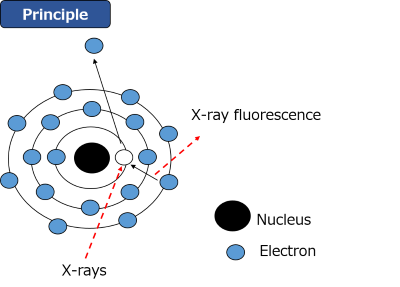
When an atom is exposed to X-rays, an electron is flipped off from an inner orbital.
Then an outer shell electron falls to a lower orbital.
The X-rays (X-ray fluorescence) corresponding to the energy difference of the two orbitals are released.
Because it is characteristic in the element, the kind of element identified by these characteristic X-rays.
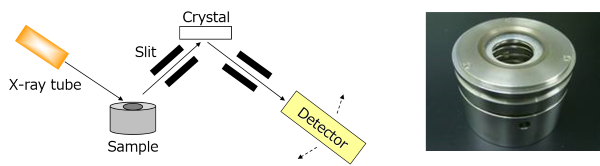
Fig. 1 Overall outline of XRF-WDX Fig.2 Sample holder
The irradiated area of X-rays are limited by the size of sample holder (10 mmφ, 20 mmφ, and 30 mmφ)
Maximum sample size : 45 mm in diameter, 40 mm in height
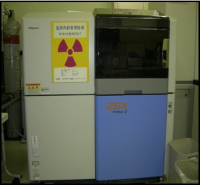
Fig.3 XRF-WDX (ZSX Primus Ⅱ (RIGAKU))
Applications
- Analysis of the major element in a substance
- Quantitative analysis of SiO2 and Al2O3 ceramics (A glass bead is prepared and measured.)
- Analysis of the element of granular materials (A press mold is prepared and measured.)